


On this page
Living in Queensland, whether it’s the Gold Coast, Brisbane, or further north, means dealing with some of the most intense heat and humidity in Australia. While we love the sunshine, it presents a significant challenge for home comfort and energy efficiency. Standard insulation approaches used in cooler southern states often fall short here. This comprehensive guide will demystify how insulation specifically tackles the QLD climate, focusing on effective strategies for cooling, moisture control, and energy efficiency. We’ll explore the science behind heat transfer, the role of different insulation types, and why a tailored approach is vital for every Queensland home.
The Queensland Climate Challenge: More Than Just Heat
Queensland’s climate is characterised by high temperatures and high relative humidity for much of the year. The sun’s radiant energy beats down on roofs, heating up attic spaces to temperatures exceeding 60°C [2]. This heat then tries to push its way into your living spaces through the ceiling and walls. Without effective insulation, your air conditioner has to work overtime, leading to astronomical energy bills and a home that never quite feels cool enough.
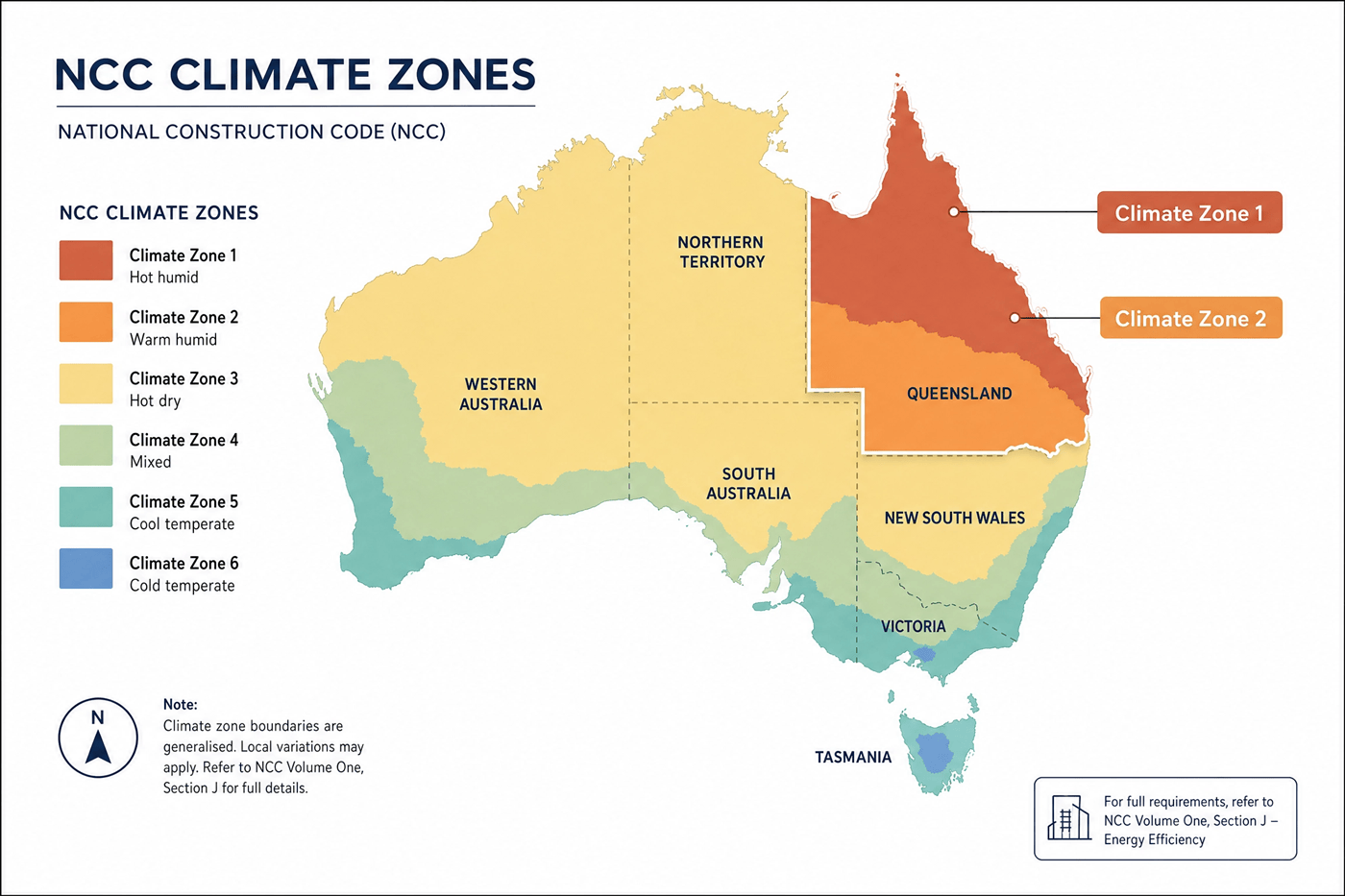
Understanding the nuances of Queensland’s climate zones, as defined by the National Construction Code (NCC), is the first step towards effective insulation. Most of coastal Queensland, including the bustling regions of Gold Coast and Brisbane, falls under **NCC Climate Zone 2 (Warm Humid)**. Further north, areas like Cairns and Townsville are classified as **Climate Zone 1 (Hot Humid)** [1]. While both zones share the challenge of heat and humidity, the intensity and duration vary, influencing the optimal insulation strategy.
The persistent high humidity, often exceeding 70% for extended periods, is a critical factor. It not only contributes to discomfort but also creates a breeding ground for mold and mildew, potentially leading to health issues and structural damage if not properly managed. This makes moisture control an equally important consideration as thermal resistance in QLD insulation solutions.

The Science of Heat Transfer in Hot Climates
To effectively insulate a home in Queensland, it’s crucial to understand how heat moves. There are three primary mechanisms of heat transfer, and in hot climates, their relative importance shifts significantly compared to cooler regions.
- Conduction: This is the transfer of heat through direct contact. Think of touching a hot metal spoon. In your home, heat conducts through solid materials like your roof tiles, ceiling plasterboard, and wall studs. Bulk insulation (like batts) primarily works by slowing down conductive heat flow.
- Convection: This involves heat transfer through the movement of fluids (liquids or gases). Hot air rising is a classic example. In your attic, superheated air can circulate and transfer heat into your living spaces. Effective sealing of air leaks and proper ventilation are key to managing convective heat transfer.
- Radiation: This is the transfer of heat through electromagnetic waves, without needing a medium. The warmth you feel from the sun or a campfire is radiant heat. In Queensland, radiant heat is the dominant factor in heat gain. The sun’s intense rays hit your roof, heating it up, and that heat then radiates downwards into your attic and home.
While all three play a role, in hot climates like Queensland, **radiant heat gain is king**. Up to 90% of the heat entering your home on a sunny day can be radiant heat [4]. This is why strategies that specifically address radiant heat are so vital for QLD homes, often more so than simply increasing bulk insulation R-values alone.

How Insulation Fights the Heat: A Multi-Layered Approach
An effective insulation system in Queensland employs a multi-layered approach, combining different types of insulation to combat all three forms of heat transfer.
Bulk Insulation (Batts)
Bulk insulation, commonly in the form of batts made from glasswool, polyester, or rockwool, works by trapping millions of tiny air pockets within its structure. These trapped air pockets significantly slow down the conductive and convective flow of heat. The effectiveness of bulk insulation is measured by its R-value, which indicates its thermal resistance. A higher R-value means better resistance to heat flow.
For Queensland ceilings, the NCC recommends minimum added ceiling insulation of around R2.5 for Climate Zone 2 (South East QLD), but most coastal homes benefit significantly from higher R-values, often up to R6.0 [3]. While glasswool is a common and cost-effective choice, polyester batts are gaining popularity in QLD due to their non-allergenic properties and inherent resistance to moisture, which is a significant advantage in humid environments.
Reflective Insulation (Sarking/Foil)
This is where the fight against radiant heat truly begins. Reflective insulation, often seen as foil sarking, works by reflecting radiant heat away from your home. It typically consists of a thin layer of aluminum foil laminated to a substrate. When installed correctly, usually under the roof tiles or metal sheeting, it can reflect up to 97% of the radiant heat from the sun before it even has a chance to penetrate your roof space [4].
The key to reflective insulation’s effectiveness is an adjacent air gap. Without this air gap, the reflective surface loses much of its ability to reflect heat. This makes proper installation crucial. In QLD, reflective insulation is not just an add-on; it’s a fundamental component of a high-performance thermal envelope, directly addressing the primary source of heat gain.
The Synergy: A Powerful Combination
Neither bulk nor reflective insulation works optimally in isolation in Queensland. Bulk insulation alone will eventually heat up under the relentless QLD sun, while reflective insulation, though excellent at blocking radiant heat, doesn’t provide significant resistance to conductive heat flow once the heat has been absorbed by the roof structure. The most effective strategy combines both:
- Reflective sarking to block the majority of radiant heat before it enters the roof space.
- High R-value bulk insulation batts to further slow down any conductive heat that manages to penetrate, ensuring a stable indoor temperature.
For Queensland homes, the ‘gold standard’ for ceiling insulation involves a combination of reflective foil sarking directly under the roof, followed by high-density bulk insulation batts (R4.1 or higher) laid over the ceiling joists. This dual approach tackles both radiant and conductive heat transfer effectively.
Mastering Moisture and Humidity Control
Beyond heat, Queensland’s high humidity poses a significant challenge. Uncontrolled moisture can lead to uncomfortable living conditions, musty odours, and the dreaded growth of mold and mildew, which can trigger allergies and respiratory issues. It can also compromise the effectiveness of your insulation and even damage your home’s structure.
Understanding Condensation
Condensation occurs when warm, moist air comes into contact with a cooler surface, causing the water vapour in the air to turn into liquid water. In QLD, this can happen in two main ways:
- Surface Condensation: Visible moisture on windows, mirrors, or cold walls. While annoying, it’s usually easy to spot and address.
- Interstitial Condensation: This is far more insidious. It occurs *within* your wall or ceiling cavities, where warm, humid indoor air (especially when air conditioning is running) meets cooler exterior surfaces. This hidden moisture can saturate insulation, reducing its R-value, and lead to timber rot, plaster damage, and extensive mold growth without you even knowing until it’s too late.
The Role of Vapor Barriers/Retarders
A vapor barrier (or vapor retarder) is a material that significantly reduces the rate at which water vapour can pass through a building assembly. Its purpose is to prevent moist air from reaching a point within the wall or ceiling where it can condense. In cold climates, vapor barriers are typically placed on the warm (interior) side of the insulation to prevent warm, moist indoor air from migrating outwards and condensing. However, in hot, humid climates like Queensland, the dynamics are often reversed [6].
When air conditioning is heavily used, the interior of the home becomes the cooler side. If a vapor barrier is placed on the interior, it could trap moisture migrating *inwards* from the hot, humid exterior, leading to interstitial condensation. Therefore, in QLD, vapor retarders are often integrated into reflective sarking and placed on the *exterior* side of the insulation, or a more breathable membrane is used to allow moisture to escape while still preventing bulk water intrusion. This is a complex area where professional advice is paramount.

The Indispensable Role of Ventilation
Ventilation is the other half of the moisture control equation. It actively removes hot, moist air from your home and roof space, preventing it from condensing and reducing the overall humidity load.
- Roof Space Ventilation: Attics in Queensland can become superheated ovens, trapping moisture and heat. Whirlybirds, eave vents, and solar-powered roof ventilators are crucial for exhausting this hot, humid air. This not only reduces the heat load on your ceiling insulation but also helps prevent condensation within the roof cavity.
- Whole-House Ventilation: Natural cross-ventilation through strategically placed windows and doors is vital. Additionally, mechanical exhaust fans in high-moisture areas like bathrooms, laundries, and kitchens are essential to remove humidity at its source.
Australian Standard AS 3999, which covers the installation of insulation, provides guidelines for managing moisture and ensuring adequate ventilation. Always ensure your insulation system complies with these standards to prevent long-term issues.
Recommended Insulation Strategies for QLD Homes
Given Queensland’s unique climate, a targeted approach to insulation is not just beneficial—it’s essential for achieving genuine comfort and energy savings. Here are the recommended strategies for different parts of your home:
Ceiling Insulation: Your First Line of Defense
The roof and ceiling are where most of the heat enters a Queensland home. Therefore, this area demands the highest R-value and a combination of insulation types.
- High R-value Bulk Batts: Aim for R4.1 to R6.0 batts. These provide substantial thermal resistance against conductive heat flow from the superheated roof space.
- Reflective Sarking: Install reflective foil sarking directly under the roof sheeting or tiles. This acts as a radiant barrier, reflecting up to 97% of the sun’s radiant heat before it can penetrate the roof cavity.
- Air Sealing: Before installing insulation, ensure all penetrations (e.g., around downlights, exhaust fans, and plumbing vents) are properly sealed to prevent air leakage, which can compromise insulation performance and introduce moisture.
Wall Insulation: Crucial for Comfort and Efficiency
While often overlooked, wall insulation plays a significant role, especially for homes with large wall areas exposed to direct sunlight.
- Wall Batts: Install R2.0 to R2.5 batts in wall cavities. This is particularly important for western-facing walls that receive intense afternoon sun.
- Reflective Foil Behind Cladding: For new builds or major renovations, consider installing reflective foil behind external wall cladding to provide an additional radiant barrier.
Underfloor Insulation: For Raised Homes
Many Queensland homes are raised off the ground, making underfloor insulation a valuable addition to prevent heat gain from the ground and improve overall thermal performance.
- Underfloor Batts: R1.5 to R2.5 batts can be installed between floor joists. Ensure they are securely fastened to prevent sagging and maintain their R-value.
The Importance of a System Approach
It’s vital to view insulation as a complete system. Each component—ceiling, walls, floor, and ventilation—works together to create a thermally efficient and comfortable home. Neglecting one area can undermine the performance of the others.
| Location | Recommended R-Value (Minimum) | Insulation Type | Key Benefit in QLD |
|---|---|---|---|
| Ceiling | R4.1 – R6.0 | Bulk Batts + Reflective Sarking | Blocks radiant heat, slows conductive heat transfer |
| Walls | R2.0 – R2.5 | Bulk Batts (in cavities) | Reduces heat gain through walls, especially western-facing |
| Underfloor (Raised Homes) | R1.5 – R2.5 | Bulk Batts | Prevents heat transfer from ground, improves floor comfort |
Beyond Comfort: Energy Efficiency & Cost Benefits
Investing in the right insulation for the QLD climate is not just about immediate comfort; it’s a smart financial decision that delivers significant long-term benefits. A well-insulated home is an energy-efficient home, leading to substantial savings and a reduced environmental footprint.
Significant Energy Bill Reductions
By effectively slowing heat transfer, insulation reduces the workload on your air conditioning system. This translates directly into lower electricity consumption and, consequently, lower energy bills. Homeowners in Queensland can expect to see reductions of up to 45% on their cooling costs during peak summer months [7]. Over the lifespan of your insulation, these savings can amount to thousands of dollars, often providing a payback period of just 2-4 years.
Increased Property Value
Energy-efficient homes are increasingly attractive to buyers in the Australian market. A home with modern, effective insulation is seen as a valuable asset, potentially increasing its resale value and market appeal. Buyers are often willing to pay a premium for homes that promise lower running costs and superior comfort.
Improved Indoor Air Quality
Proper insulation, especially when combined with effective moisture control and ventilation, helps prevent the growth of mold and mildew. This leads to a healthier indoor environment, reducing the presence of allergens and improving air quality, which is particularly beneficial for residents with respiratory sensitivities.
Environmental Responsibility
By reducing your home’s energy consumption, you also contribute to a lower carbon footprint. Less demand on power grids means less reliance on fossil fuels, making your home more environmentally friendly.
Keep an eye on Queensland government initiatives and federal programs that may offer rebates or incentives for energy-efficient home improvements, including insulation upgrades. These can further reduce your upfront investment and accelerate your payback period.
Why Professional Installation is Non-Negotiable in QLD
While the principles of insulation might seem straightforward, the execution, especially in a challenging climate like Queensland’s, requires expertise. DIY insulation, while seemingly cost-effective upfront, can lead to critical errors that compromise performance and even create new problems.
- Complexity of QLD Climate: Understanding the unique heat transfer mechanisms and moisture dynamics of a hot, humid environment is crucial. Professionals are trained to select the right materials and installation techniques for these specific conditions.
- Avoiding Common Mistakes: Improper installation can lead to thermal bridging (gaps in insulation), compression (reducing R-value), or incorrect vapor barrier placement (trapping moisture). These errors can negate the benefits of insulation and even cause structural damage or mold growth.
- Safety: Attics and roof spaces can be hazardous environments, with exposed electrical wiring, extreme temperatures, and potential for falls. Professional installers are trained in safety protocols and have the right equipment to work safely.
- Compliance: Adherence to Australian Standards (like AS 3999) and the National Construction Code (NCC) is essential. Professionals ensure your installation meets these regulatory requirements, which is important for insurance and future property sales.
- Guaranteed Performance: A professional installation comes with the peace of mind that your insulation will perform as expected, delivering its promised R-value and benefits for years to come. Express Insulation Australia specialises in QLD-specific solutions, ensuring optimal results.
For a deeper dive into the differences, refer to our guide on DIY vs. Professional Insulation Installation: What You Need to Know.
Conclusion
Queensland’s hot and humid climate demands a sophisticated approach to home insulation. By understanding the science of heat transfer, strategically combining bulk and reflective insulation, and meticulously managing moisture, homeowners can transform their living spaces. The result is a home that remains cool, dry, and comfortable year-round, significantly reducing energy consumption and contributing to a healthier environment. Don’t let the Queensland sun dictate your comfort or your energy bills. Investing in a tailored, professionally installed insulation solution is the smartest way to ensure your home is prepared for the unique challenges of our climate.
Contact Express Insulation Australia today for a free, no-obligation assessment. Our experts will design a custom insulation strategy perfectly suited to your Queensland home, ensuring maximum comfort and energy savings.
References
- YourHome.gov.au – Insulation
- Energy.gov.au – Tropical and sub-tropical living
- Insulation.team – What Climate Zone Am I In? NCC R-Value Requirements (QLD)
- RIMA International – Myths & Misconceptions – Radiant Barrier, Reflective Insulation
- Insulation Institute – Moisture Control | Vapor Retarders
- FineHomebuilding.com – Insulation in Hot, Humid climate (forum discussion on vapor barrier placement)
- West Fraser OSB – Radiant Barriers: Myths Busted and Facts Explained
Leave a Reply