

On this page
Australia’s building landscape is undergoing its most significant transformation in a decade. With the full adoption of the National Construction Code (NCC) 2022 standards, the benchmark for new residential dwellings has shifted from 6 stars to a mandatory 7-star NatHERS rating. For homeowners and builders in Queensland, particularly across the Gold Coast and Brisbane, this isn’t just a regulatory hurdle—it’s a blueprint for superior thermal comfort and long-term energy savings. At the heart of this transition is insulation, the most cost-effective lever for hitting that 7-star target.
The 7-Star Standard: What It Means for QLD Homeowners
The shift from 6 to 7 stars represents an approximate 25% reduction in the energy required to heat and cool a home. In the subtropical climate of Queensland, where air conditioning accounts for a massive portion of household utility bills, this improvement is felt immediately in both comfort and cost.
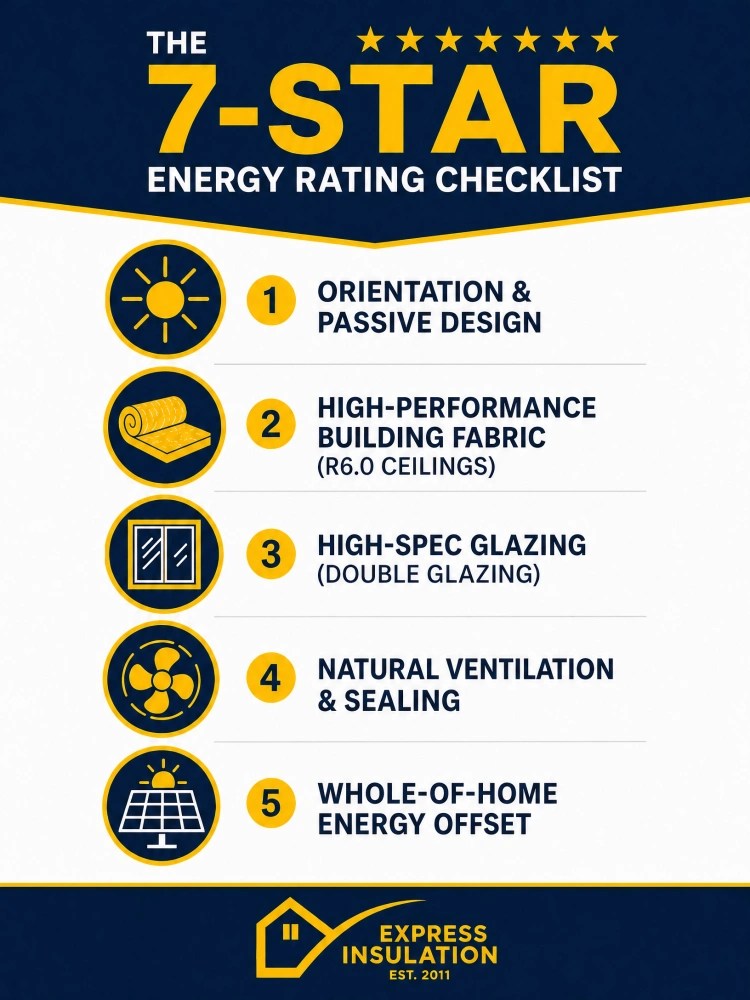
A 7-star rating is calculated based on the home’s “thermal envelope.” This includes building orientation, glazing performance, and most importantly, the building fabric. Under the new code, achieving these stars requires a “fabric first” approach. This means ensuring the shell of the home is as airtight and well-insulated as possible before relying on mechanical heating or cooling.
Key Insulation Requirements for NCC 2022 Compliance
Achieving 7 stars in Queensland (predominantly Climate Zone 2) requires a strategic selection of materials. The “standard” insulation levels of the past are no longer sufficient to meet the rigorous thermal modelling required for certification. Understanding R-values in Australian homes is the first step toward compliance.
1. Ceiling and Roof Insulation Upgrades
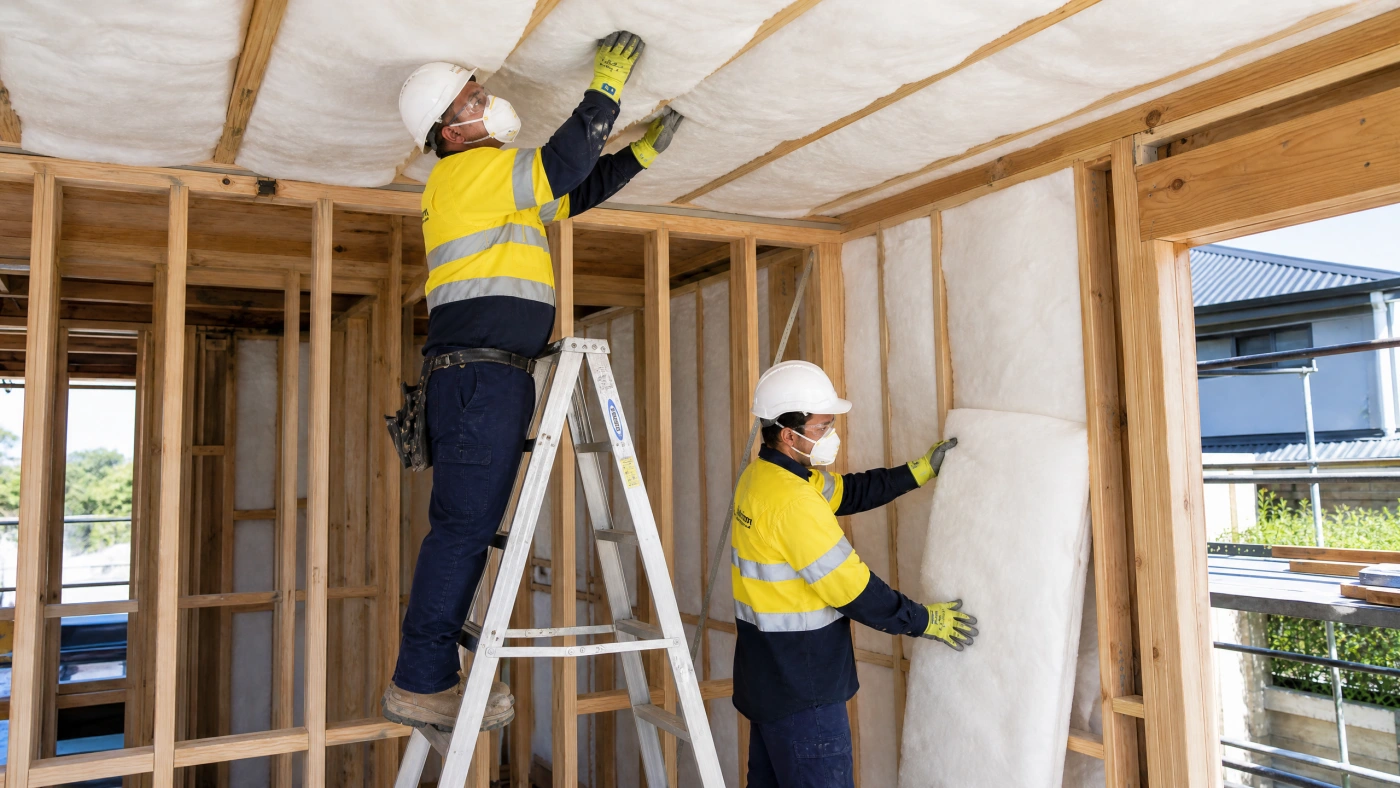
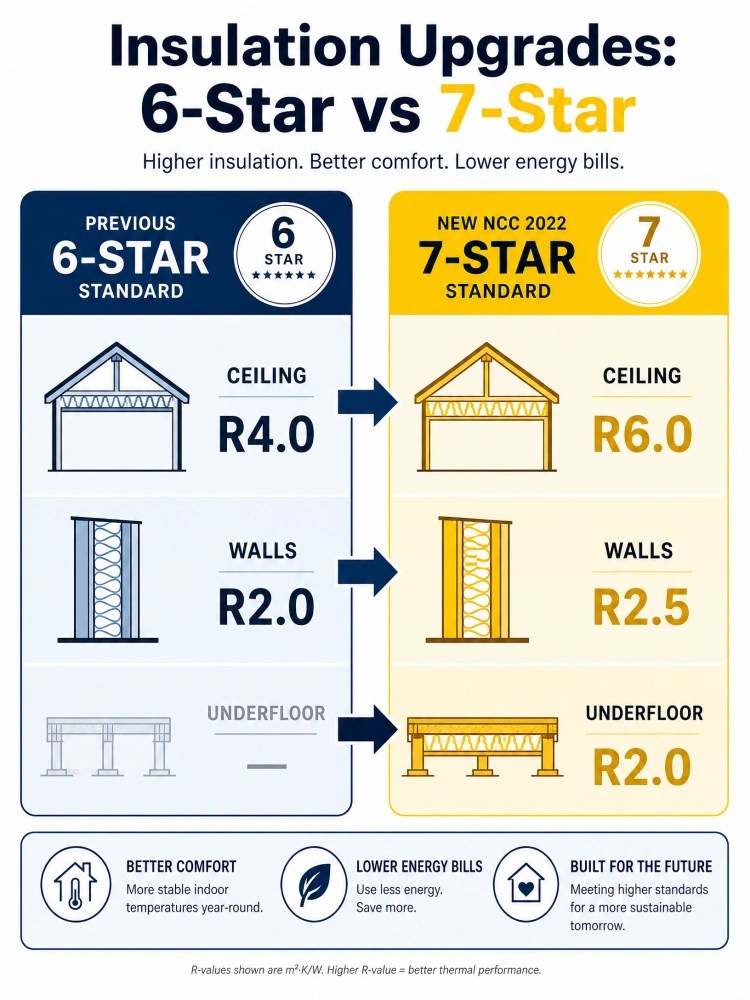
The roof is the primary entry point for heat in the Sunshine State. Under the 6-star code, R4.0 ceiling batts were the industry standard. To hit 7 stars, many building designers are now specifying R5.0 or R6.0 ceiling insulation. This upgrade provides a thicker thermal barrier that prevents the blistering QLD summer heat from radiating into the living spaces. Proper ceiling batt installation is vital to maintain these R-values.
2. External Wall Insulation and Thermal Bridging
External walls are the second most critical area. The NCC 2022 has introduced stricter rules regarding thermal bridging, particularly in steel-framed homes. Steel conducts heat much more efficiently than timber, creating “bridges” that allow heat to bypass your insulation. To compensate, builders must now use higher R-value batts (typically R2.5) and external wall insulation systems to ensure the “Total R-value” meets the code.

3. Underfloor Insulation for Raised Homes
For classic Queenslanders or modern homes built on stumps, underfloor insulation is no longer optional. Uninsulated floors are a major source of heat gain in summer and heat loss during winter mornings. Installing R2.0 or R2.5 underfloor batts is essential for creating a complete thermal seal.
The Whole-of-Home Rating: Beyond the Shell
One of the most significant changes in the NCC 2022 is the introduction of the Whole-of-Home (WoH) rating. While the 7-star rating focuses on the building’s shell, the WoH score looks at the energy consumption of fixed appliances, including hot water systems, air conditioning, lighting, and pool pumps.
To pass, a home must achieve a WoH score of at least 60 out of 100. High-quality insulation directly supports this score by reducing the load on the air conditioning system, allowing for smaller, more efficient units to be installed. This synergy between the building fabric and appliances is the future of sustainable Australian housing.
If your building design struggles to hit the WoH score of 60, installing a Solar PV system is the most common way to offset appliance energy use and achieve compliance.
Designing for Climate Zone 2: The Subtropical Strategy
The Gold Coast and Brisbane sit within Climate Zone 2, characterised by high humidity and hot summers. Insulation strategy here differs significantly from the southern states. You can learn more about how insulation works in hot humid climates to better understand these nuances.
| Component | Previous Standard (6-Star) | NCC 2022 Target (7-Star) |
|---|---|---|
| Ceiling Insulation | R4.0 Batts | R5.0 – R6.0 Batts |
| External Walls | R1.5 – R2.0 Batts | R2.5 High-Density Batts |
| Underfloor | Often None | R2.0 – R2.5 Batts |
| Roof Sarking | Standard Grade | Heavy Duty Reflective |
DtS vs. Performance Solutions: Which Path to Take?
There are two primary ways to prove your home meets the NCC standards:
- Deemed-to-Satisfy (DtS): Following the specific “recipe” of R-values and materials laid out in the NCC Housing Provisions. This is straightforward but can be restrictive for modern designs.
- Performance Solutions (NatHERS Modelling): Using accredited software to model the home’s energy use. This allows for flexibility—for example, using higher-spec insulation to compensate for large areas of glazing.
Most 7-star homes in QLD are now using NatHERS modelling, as it allows builders to optimise the insulation spend to achieve the best result for the specific site and design. Consulting with professional insulation installers early in the design phase can save thousands in unnecessary material costs.
The Benefits of 7-Star Compliance
While the initial construction cost may rise slightly (estimated between 1% and 3% of the total build), the long-term benefits are undeniable:
-
Reduced Utility Bills Lower reliance on air conditioning leads to significant annual savings on electricity.
-
Increased Property Value Energy-efficient homes are increasingly sought after by buyers who value sustainability.
-
Superior Comfort Consistent indoor temperatures year-round, without the “hot spots” common in older homes.
Leave a Reply