

On this page
For Gold Coast homeowners living in properties built before 2005, the insulation hidden above your ceiling may be silently degrading — losing its thermal performance, harbouring contaminants, or even posing health risks. The question of whether to remove old insulation or simply add new material on top is one that thousands of Queensland homeowners face each year. Getting the answer wrong can mean trapping moisture, sealing in pest contamination, or wasting money on insulation that cannot perform as intended. This comprehensive guide helps you understand when insulation removal is genuinely necessary, what the process involves, and how to make the most informed decision for your home and budget.
When Is Insulation Removal Actually Necessary?
Not every home with old insulation requires a complete removal. In many cases, existing insulation that remains clean, dry, and structurally sound can be topped up with new material to achieve modern R-Value requirements. However, there are specific circumstances where removal is not just recommended — it is essential for the health of your home and family.
Insulation removal becomes necessary when the existing material has been compromised in a way that prevents it from performing its intended function, or when it poses a health or safety risk. The most common triggers on the Gold Coast include water damage from roof leaks (particularly after severe storm seasons), pest contamination from rodents and possums that have nested in the roof cavity, and mould growth caused by Queensland’s high humidity levels.
The Queensland Health Department advises that contaminated insulation materials can release airborne particles into the living space below through ceiling penetrations, downlights, and exhaust fan openings. This is particularly concerning for households with asthma sufferers, young children, or elderly residents. When contamination is present, removal is a health imperative rather than a discretionary upgrade.
Six Warning Signs Your Insulation Needs Removal
Identifying whether your insulation needs removal starts with recognising the warning signs. Some are visible from inside your home, while others require a roof cavity inspection to confirm. If you notice any of the following indicators, it is time to arrange a professional assessment. For a broader overview of when your home’s insulation may be underperforming, see our guide on signs your home needs new or upgraded insulation.

1. Water Damage and Staining
Water-damaged insulation is the most urgent removal trigger. When fibreglass or polyester batts absorb water — from roof leaks, overflowing gutters, or condensation — they lose virtually all thermal resistance. Wet insulation also becomes a breeding ground for mould and can cause structural damage to ceiling joists and plasterboard. On the Gold Coast, where severe storms and heavy rainfall are common, water damage is the leading cause of insulation failure.
2. Pest Contamination
Rodents, possums, and birds frequently nest in Queensland roof cavities. Their droppings, urine, and nesting materials contaminate insulation with bacteria, parasites, and allergens. Once contaminated, the insulation cannot be cleaned — it must be removed and the cavity sanitised before new material is installed.
3. Visible Mould or Musty Odours
Mould thrives in the warm, humid conditions common in Gold Coast roof cavities. If you notice musty odours in your home or see mould growth on ceiling surfaces, the insulation above may be heavily affected. Mould spores from contaminated insulation can circulate through the home via air conditioning systems and ceiling penetrations.
4. Severe Compression or Sagging
Insulation works by trapping air within its fibres. When batts are compressed — by stored items, foot traffic during maintenance, or simply gravity over decades — the trapped air pockets collapse and thermal performance drops dramatically. Batts compressed to half their original thickness lose approximately 50% of their R-Value.
5. Age-Related Degradation
While modern insulation products can last 50+ years in ideal conditions, older materials installed before the 2000s often degrade faster. Early fibreglass batts were manufactured with less durable binders that break down over time, causing the material to crumble and settle. If your home was built in the 1970s–1990s and the insulation has never been replaced, a professional inspection is strongly recommended.
6. Asbestos-Containing Material
Some insulation products manufactured before 1990 in Australia contained asbestos fibres. Loose-fill asbestos insulation (known as “Mr Fluffy” in some states) is extremely hazardous. While this specific product was primarily used in the ACT and NSW, other asbestos-containing insulation materials were used across Queensland. If your home was built before 1990 and you suspect asbestos, do not disturb the material — engage a licensed asbestos assessor immediately.
Remove and Replace vs Top-Up: Making the Right Decision
The decision between full removal and a simple top-up depends entirely on the condition of your existing insulation. This is not a decision that should be made without a physical inspection of the roof cavity. What appears adequate from below may reveal significant problems when examined up close.
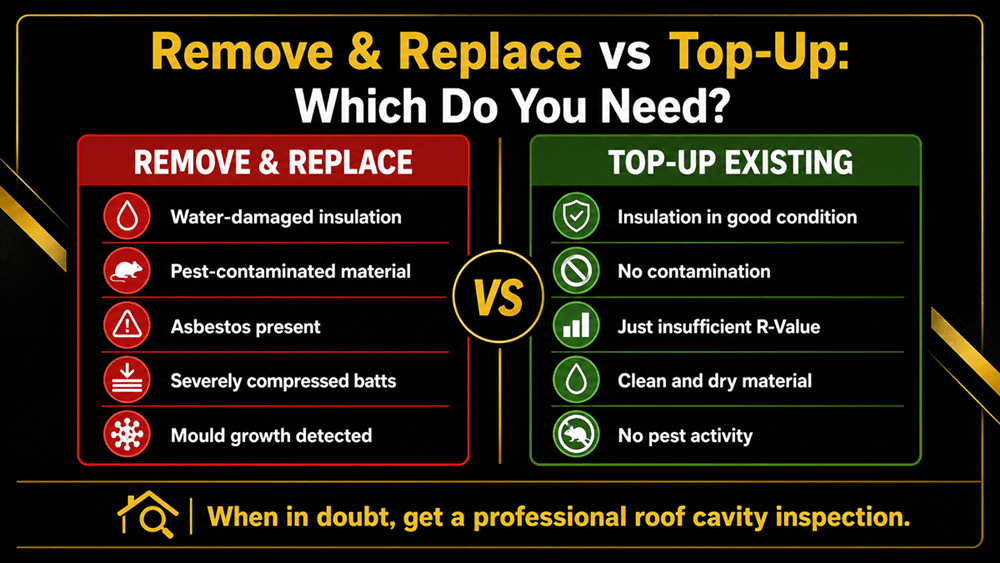
| Condition | Recommended Action | Reason |
|---|---|---|
| Water-damaged or wet batts | Remove & Replace | Wet insulation breeds mould and has zero thermal value |
| Rodent/possum contamination | Remove & Replace | Cannot be decontaminated; health hazard |
| Mould growth present | Remove & Replace | Spores spread through home; cannot be remediated in-situ |
| Asbestos identified | Licensed Removal | Legal requirement; extreme health hazard |
| Compressed but clean and dry | Remove & Replace | Compressed batts cannot regain loft; new material needed |
| Clean, dry, intact but low R-Value | Top-Up | Existing material still contributes; add new layer on top |
| Good condition, meets current standards | No action needed | Insulation is performing as intended |
If you are unsure about the condition of your insulation, request a free roof cavity inspection from a professional insulation company. At Express Insulation, we provide honest assessments — if a top-up is sufficient, we will tell you. Unnecessary removal benefits no one and we pride ourselves on transparent advice.
Gold Coast-Specific Factors That Accelerate Degradation
The Gold Coast’s subtropical climate creates conditions that accelerate insulation degradation compared to cooler, drier regions of Australia. Understanding these local factors helps homeowners anticipate when their insulation may need attention. For more on how Queensland’s climate affects insulation performance, see our article on how insulation works in hot, humid climates.
High Humidity and Condensation
The Gold Coast’s average relative humidity exceeds 70% for much of the year. In roof cavities with inadequate ventilation, this moisture-laden air condenses on cooler surfaces — particularly during winter mornings when the metal roof cools overnight. Over time, this condensation saturates insulation batts, promoting mould growth and reducing thermal performance. Homes without adequate roof ventilation are particularly vulnerable.
Severe Storm Damage
The Gold Coast experiences an average of 30–40 thunderstorm days per year, with severe hailstorms and heavy rainfall events becoming increasingly common. Even minor roof damage — a displaced tile, a cracked ridge cap, or a lifted sheet — can allow water ingress that goes unnoticed for months, silently saturating the insulation below. After any significant storm event, a roof and cavity inspection is advisable.
Pest Pressure
Queensland’s warm climate supports a thriving population of roof-dwelling pests. Rats, mice, possums, and carpet snakes are all common in Gold Coast roof cavities. These animals not only contaminate insulation but also compress it by creating nesting hollows and runways through the material. The Queensland Government notes that possums are a protected species, requiring humane removal before insulation work can proceed.
Extreme Roof Cavity Temperatures
Gold Coast roof cavities can reach temperatures exceeding 70°C during summer. Over decades, these extreme temperatures accelerate the breakdown of binder resins in older fibreglass products, causing the material to become brittle, dusty, and less effective. Modern insulation products are manufactured with more heat-stable binders, but older installations from the 1980s and 1990s are particularly susceptible to heat-related degradation.
The Professional Insulation Removal Process
Professional insulation removal is a systematic process designed to safely extract contaminated or degraded material without spreading contaminants into the living space below. It requires specialised equipment, proper safety protocols, and experienced technicians who understand the unique challenges of working in Queensland roof cavities.
-
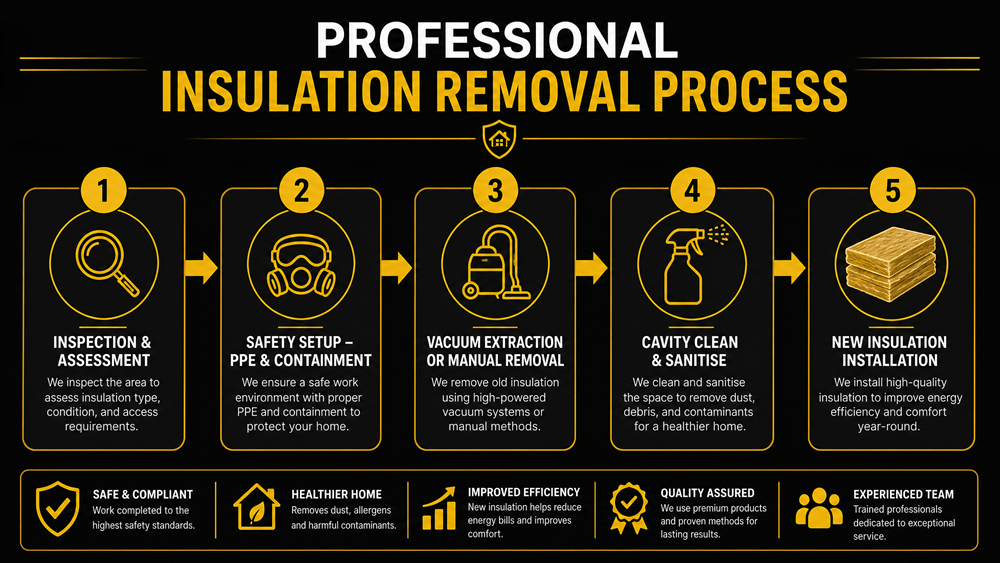
Inspection and Assessment A qualified technician inspects the roof cavity to assess the insulation type, condition, extent of damage or contamination, and access requirements. This determines the removal method and any special precautions needed (e.g., asbestos testing).
-
Safety Setup and Containment The work area is prepared with protective sheeting, and technicians don full PPE including P2 respirators, safety goggles, and disposable coveralls. Ceiling penetrations (downlights, exhaust fans) are sealed to prevent debris falling into the living space.
-
Vacuum Extraction or Manual Removal For loose-fill insulation, an industrial vacuum system extracts the material directly into sealed disposal bags. For batt insulation, batts are carefully rolled and bagged by hand. All material is removed from the property for licensed disposal.
-
Cavity Clean and Sanitise Once the old insulation is removed, the cavity is vacuumed clean of dust, debris, and contaminants. Where pest contamination is present, a sanitising treatment is applied to eliminate bacteria and odours before new insulation is installed.
-
New Insulation Installation Fresh, high-performance insulation is installed to meet or exceed current NCC requirements (minimum R4.1 for Climate Zone 2 ceilings). This is the opportunity to upgrade to a higher R-Value for improved comfort and energy savings.
The entire process typically takes one day for a standard Gold Coast home (150–250m² ceiling area). For larger properties or those with significant contamination, the process may extend to two days. At Express Insulation, our professional installation team handles the complete process from assessment through to new insulation installation.
Safety Considerations and Asbestos Awareness
Insulation removal is not a DIY task. The risks associated with working in confined roof cavities — extreme heat, poor air quality, electrical hazards, and potential asbestos exposure — make professional removal the only safe option. The Workplace Health and Safety Queensland guidelines are clear on the safety requirements for this type of work.
Asbestos: Know Before You Disturb
Any home built before 1990 in Queensland may contain asbestos in various building materials, including some insulation products. Under the Work Health and Safety Regulation 2011 (QLD), disturbing asbestos-containing material without proper licensing is illegal and carries severe penalties. If there is any doubt about whether your insulation contains asbestos, a sample must be tested by a NATA-accredited laboratory before any removal work begins.
Never attempt to remove insulation yourself if you suspect asbestos. Disturbing asbestos fibres without proper containment can release microscopic particles that cause mesothelioma and asbestosis — serious, often fatal diseases. Only a licensed Class A or Class B asbestos removalist may legally remove asbestos-containing insulation in Queensland.
Heat Stress in Queensland Roof Cavities
Roof cavity temperatures on the Gold Coast regularly exceed 60°C during summer months. Working in these conditions without proper hydration, rest breaks, and heat management protocols can lead to heat exhaustion or heat stroke. Professional teams schedule removal work during cooler morning hours and follow strict heat management procedures. This is another compelling reason why insulation removal should never be attempted as a DIY project — particularly between October and March.
What Comes After Removal: Upgrading Your Insulation
Insulation removal presents a valuable opportunity to upgrade your home’s thermal performance to modern standards. Homes built before 2003 were typically insulated to R2.5 or lower — well below the current NCC requirement of R4.1 for ceiling insulation in Climate Zone 2 (Gold Coast). Upgrading to R5.0 or R6.0 during the replacement process delivers significantly better comfort and energy savings for a modest additional investment.
When selecting replacement insulation, consider both thermal and acoustic performance. Modern glasswool and polyester batts offer excellent thermal resistance while also reducing external noise from rain, traffic, and aircraft — a common concern for Gold Coast residents near the airport flight path. For detailed guidance on choosing the right product, see our article on best insulation solutions and our comprehensive guide to optimising comfort with ceiling insulation.
The cost of removal and replacement is typically recovered within 3–5 years through reduced energy bills. A properly insulated Gold Coast home can save between $400 and $900 per year on air conditioning costs alone, according to data from the Australian Government’s YourHome initiative. When you factor in improved comfort, better indoor air quality, and increased property value, the return on investment is compelling.
Frequently Asked Questions
How much does insulation removal cost on the Gold Coast?
Professional insulation removal on the Gold Coast typically costs between $1,500 and $4,000 for a standard home, depending on the ceiling area, insulation type (batts vs loose-fill), extent of contamination, and access difficulty. This usually includes vacuum extraction, cavity cleaning, and disposal. New insulation installation is quoted separately, with combined removal-and-replace packages offering the best value.
Can I just put new insulation on top of old insulation?
You can top up existing insulation only if the current material is clean, dry, free from contamination, and not severely compressed. If any of these conditions are not met, the old material must be removed first. Placing new insulation over contaminated or wet material traps the problem and can worsen indoor air quality and structural damage.
How do I know if my insulation contains asbestos?
If your home was built before 1990, there is a possibility that insulation materials may contain asbestos. You cannot identify asbestos by sight alone — it requires laboratory testing. Engage a licensed asbestos assessor to take a sample for NATA-accredited analysis. Do not disturb, cut, or remove any suspected material yourself.
How long does insulation removal take?
For a standard Gold Coast home (150–250m² ceiling area), professional insulation removal typically takes 4–8 hours, depending on the material type and extent of contamination. If new insulation is being installed on the same day, the complete process (removal + installation) usually takes a full day. Larger homes or heavily contaminated cavities may require two days.
Is insulation removal covered by home insurance?
Insulation removal may be covered by home insurance if the damage was caused by a covered event — such as storm damage causing a roof leak that saturated the insulation. General wear and tear, pest damage, and age-related degradation are typically not covered. Check your policy and lodge a claim before arranging removal if storm damage is the cause.
What R-Value should I install after removal?
The current NCC minimum for ceiling insulation in Climate Zone 2 (Gold Coast) is R4.1. However, we recommend installing R5.0 or R6.0 for optimal comfort and energy savings. The additional cost of upgrading from R4.1 to R6.0 is relatively small compared to the total project cost, and the improved performance pays for itself through lower energy bills within 2–3 years.
Leave a Reply